
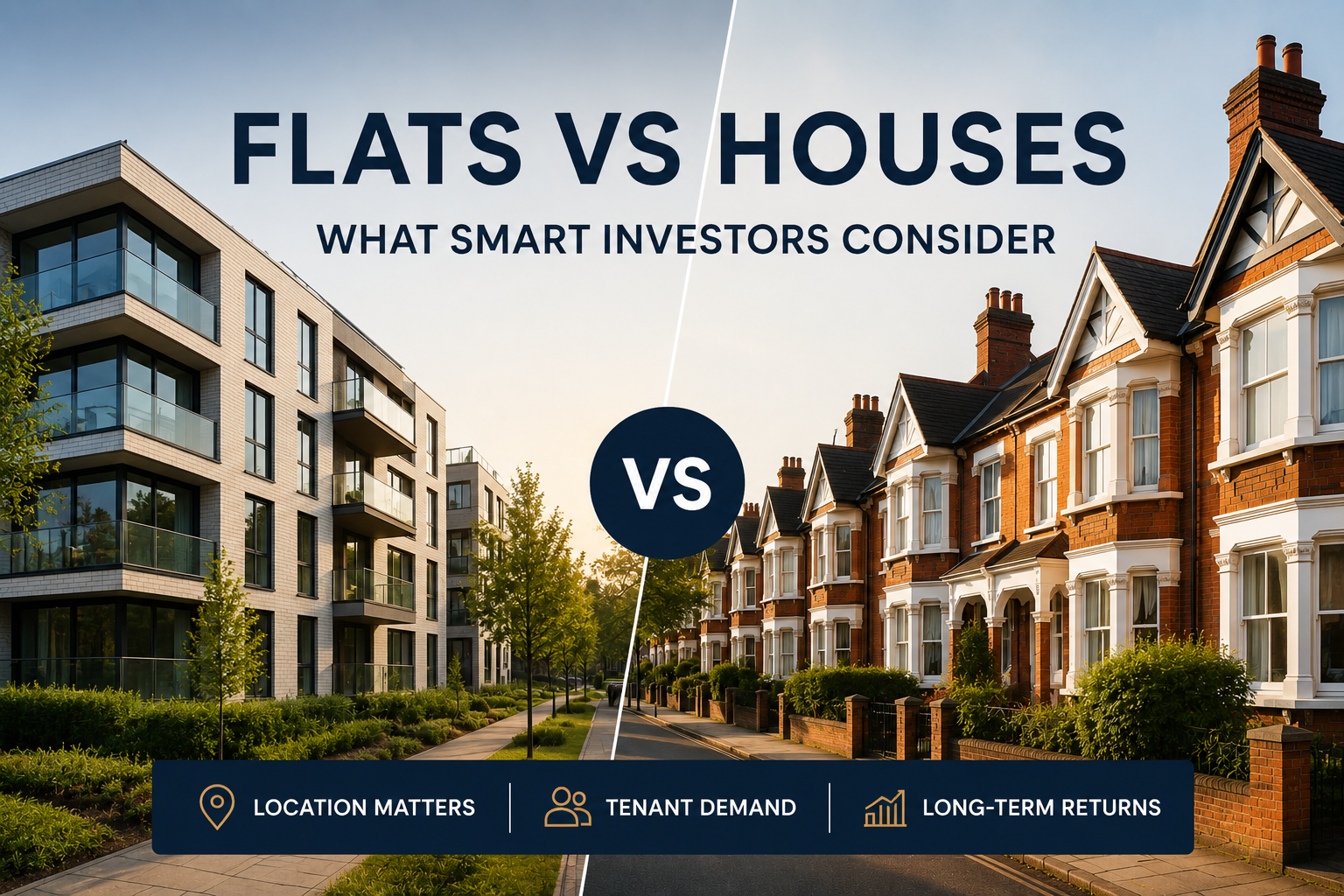
One of the most common questions property investors ask is whether flats or houses make better investments.
The answer, however, is rarely straightforward. Too often, the debate is reduced to blanket statements: "Houses always outperform" or "Flats never grow."
At Ethira Property Group, we take a different approach. We do not start with the asset; we start with the outcome. The more important question is:
Which property is most likely to achieve the long-term objectives you’ve set for your portfolio?
For some investors in 2026, that may be a flat. For others, a house may make more sense. The key lies in understanding the market fundamentals rather than relying on assumptions or anecdotes.
Why the Flats vs Houses Debate Often Misses the Point
Many investors base their decisions on stories, not data.
- A friend bought a house that doubled in value.
- A landlord complains about high service charges in their flat.
- Another sees flats underperforming in certain areas of London.
These experiences are genuine but often misleading if taken as universal truths. Property performance is rarely dictated solely by asset type.
Instead, performance is influenced by factors such as:
- Local housing demand
- Tenant demographics and disposable income
- Employment growth and major employers
- Affordability constraints
- Transport and infrastructure
- Supply pipelines
- Transaction volumes
- Availability of mortgage finance
These fundamentals almost always outweigh whether the property is a flat or a house.
Not All Flats Are Created Equal
One of the biggest mistakes investors make is lumping all apartments together.
There is a substantial difference between a mid-rise apartment in a well-located development and a luxury high-rise with extensive amenities.
Many premium developments offer:
- Swimming pools, gyms, cinemas, lounges
- Concierge services
- Roof terraces and co-working spaces
While these features can be impressive, they are usually funded through higher service charges. Tenants often do not use these amenities enough to justify the cost, which can reduce net returns.
Similarly, high-rise buildings often carry significantly higher insurance premiums, lift maintenance costs, fire compliance obligations, and general upkeep.
The experienced investor does not automatically dismiss flats. They filter out developments where excessive running costs outweigh the benefits and focus on buildings where service charges are reasonable, transparent, and proportionate to the benefits provided.
Rising Service Charges: The Context Many Investors Miss
Service charges and maintenance costs have increased over the past five to six years. Many flat owners are frustrated by this, but it’s important to recognise the broader context.
Since 2020, the UK has faced:
- Pandemic disruption
- Inflationary pressures following quantitative easing
- Rising energy and labour costs
- The war in Ukraine
These forces have affected all property ownership. A homeowner replacing a roof, windows, or heating system today is unlikely to pay the same prices as five years ago. The same is true for flats.
The key question is not that costs have risen, but whether they are proportionate, well-managed, and support long-term tenant demand.
Lease Length and Management Quality Matter
Leasehold flats require careful consideration. Short leases (i.e less than 125 year remaining) can affect mortgage availability, resale prospects, and long-term growth. Similarly, poorly managed developments can experience escalating costs over time.
Experienced investors examine:
- Lease length
- Management company quality
- Reserve fund provisions
- History of major works
- Service charge trends
A well-managed, sensible development can outperform an expensive luxury high-rise burdened with unnecessary costs, even if it looks less glamorous.
London Apartments: Affordability, Not Asset Type, Drives Performance
Many investors cite the lack of capital growth in London flats as evidence that apartments underperform. However, the reality is different.
Since Help to Buy ended, affordability has become a significant constraint. The average London flat may cost around £600,000, while the typical skilled income in the area is £60,000. To secure a mortgage under conventional lending rules, a household may need an income closer to £150,000.
This does not mean flats are poor investments. It means the market is constrained by affordability. Transaction volumes have slowed and prices have moderated, but this is largely a finance issue rather than an asset-class issue.
Experienced investors recognise this distinction. They understand that credit availability, not property type, drives short-term price performance in certain London markets.
Houses Are Not Automatically Better
Houses are often perceived as safer investments. They do have advantages:
- Larger land footprint
- Family appeal
- Extension opportunities
But a house in a declining location or with weak tenant demand may underperform a well-chosen apartment elsewhere.
Again, the key is the market fundamentals rather than the asset type.
How Experienced Investors Think Differently
Less experienced investors often start with a predetermined conclusion:
“I only buy houses.”
“I only buy flats.
Experienced investors begin with questions:
- Which property aligns with my long-term objectives?
- Which location has the strongest tenant demand?
- Where are affordability and transaction volumes supportive?
- Which property offers the best risk-adjusted return?
This approach ensures investment decisions are evidence-based, not emotional.
Key Takeaways for 2026 Investors
- Location and tenant demand matter more than asset type.
- High service charges, luxury amenities, and high-rise insurance can erode returns.
- Rising costs are not unique to flats; housing costs have increased everywhere.
- Lease length and building management quality are critical.
- Affordability constraints drive London’s apartment market performance, not the fact that they are flats.
- Experienced investors filter opportunities based on outcomes, not stereotypes.
In short: the right investment depends on the location, tenant demand, and required returns not whether it’s a flat or a house.
If you would like a second opinion on your existing portfolio or future investment plans, arrange a complimentary consultation with Ethira Property Group. Our role is to help investors assess opportunities through the lens of strategy, risk and long-term outcomes, rather than relying on broad assumptions or one size fits all advice.